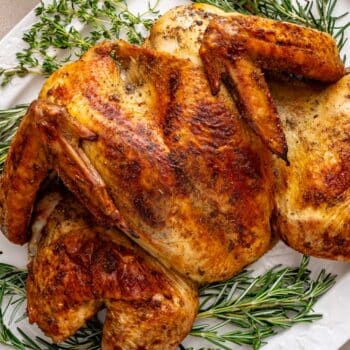
Dry Brined Spatchcock Turkey Recipe
This dry brined spatchcock turkey will be your Thanksgiving centerpiece! Say goodbye to dry and flavorless turkey from here on out.
Prep Time: 15 minutes
Cook Time: 1 hour 15 minutes
Total Time: 1 day 1 hour 30 minutes
Makes: 12 servings
Ingredients
Dry Brine
- 2 1/2 tablespoons kosher salt*
- 1 tablespoon brown sugar
- 1 teaspoon ground white pepper
- 2 teaspoons rubbed sage
- 2 teaspoons ground marjoram
- 1 teaspoon garlic powder
- 1 teaspoon ground ginger
Turkey
- 12-14 lb fresh or heritage turkey
- 1/2 cup salted butter, room temperature (4 oz / 1 stick)
- 1 onion, chopped
- 3 large carrots, chopped
- 4 celery ribs, chopped
- 2 fresh bay leaves
- 1 bunch fresh sage
- 1 bunch fresh thyme
- 2 sprigs fresh rosemary
- 1 recipe homemade turkey gravy
Instructions
- Spatchcock the turkey. First, remove the neck and giblets from the turkey and make sure it's completely defrosted (if using a frozen turkey). Place the turkey on a large cutting board and pat it very dry with paper towels. Arrange the turkey breast-side down on the cutting board with the legs facing you. Using good-quality kitchen shears, cut along one side of the turkey spine, separating it from the ribs. Be sure to cut as close to the spine as you can so that you do not end up discarding any more of the turkey meat than necessary. Repeat on the other side of the spine. Flip the turkey so that the breasts face upward and the legs face outward. Using the palm of your hands, press along the breast bone. You should hear a small crack and the bird should lay flat. (Watch the video in the blog post above for a quick tutorial.)
- Make the dry brine. Whisk the dry brine ingredients together in a small bowl.
- Dry brine the turkey for at least 24 hours. Line a rimmed baking sheet with foil and place the turkey, breast side up, on the sheet. Using your fingers, separate the skin from the meat of the turkey. Rub the bird all over with the dry brine, including under the skin and on the underside of the bird. Refrigerate uncovered for at least 24 hours, but 2-3 days yields the best results.
- Preheat an oven to 400ºF.
- Prep your turkey for roasting. In a large roasting pan or a large rimmed baking sheet lined with foil, mix the onions, carrots, and celery together. Top with the bay leaves, sage, thyme, and rosemary. Remove the dry brined turkey from the fridge and place it on top of the veggies. Smear the softened butter all over the skin and under it, evenly coating the turkey.
- Roast. Roast until a probe thermometer registers 165ºF at the thickest part of the thigh and 155ºF at the thickest part of the breast, about 70-80 minutes. Remove from the oven and transfer to a cutting board and lightly tent with foil. Rest 20-30 minutes before slicing.
- Make gravy from the drippings (optional). Pour the turkey drippings from the pan into a heat-safe container, pressing on the veggies to extract as much as possible. Then, use the drippings to make homemade turkey gravy.
Notes
You can increase the size of the turkey to 14-16 lbs. Increase the salt in the brine to 3 tablespoons and adjust the cooking time accordingly.
*Salt: If you're using a finer salt than kosher salt (such as table salt), reduce the amount by half.
Nutrition
Serving: 4ozCalories: 270kcalCarbohydrates: 2gProtein: 28gFat: 12gSaturated Fat: 6gCholesterol: 100mgSodium: 1000mgSugar: 2g
